


A note on the words: juwari soba is buckwheat noodles made from one hundred percent buckwheat flour, with no wheat added. Tanuki soba is soba topped with agedama (also called tenkasu), the crisp bits of fried tempura batter; negi is Japanese long onion and tsuyu is the soy-based broth. Sobayu is the starchy water the soba was boiled in, poured out at the end of the meal to drink. “Jiro-style” describes the black-on-yellow signage associated with the Ramen Jiro chain. Izakaya means Japanese pub.
Akebonoya, House-Made Juwari Soba and Local Sake on Tabelog (English) — opening hours, payment details and the Japanese address are kept up to date there, not here.
Hello, this is Hangover Meshi. So, I had some shopping to do and headed to Yurakucho! In truth I had drunk a little too much the day before and was feeling somewhat hungover, so I was walking toward Hibiya Station thinking I wanted to put something light in my stomach — and there under the railway arches was a place I did not recognize. Hm? Was this here before? (Looking into it later, it seems it had in fact been there quite a while, ha.)
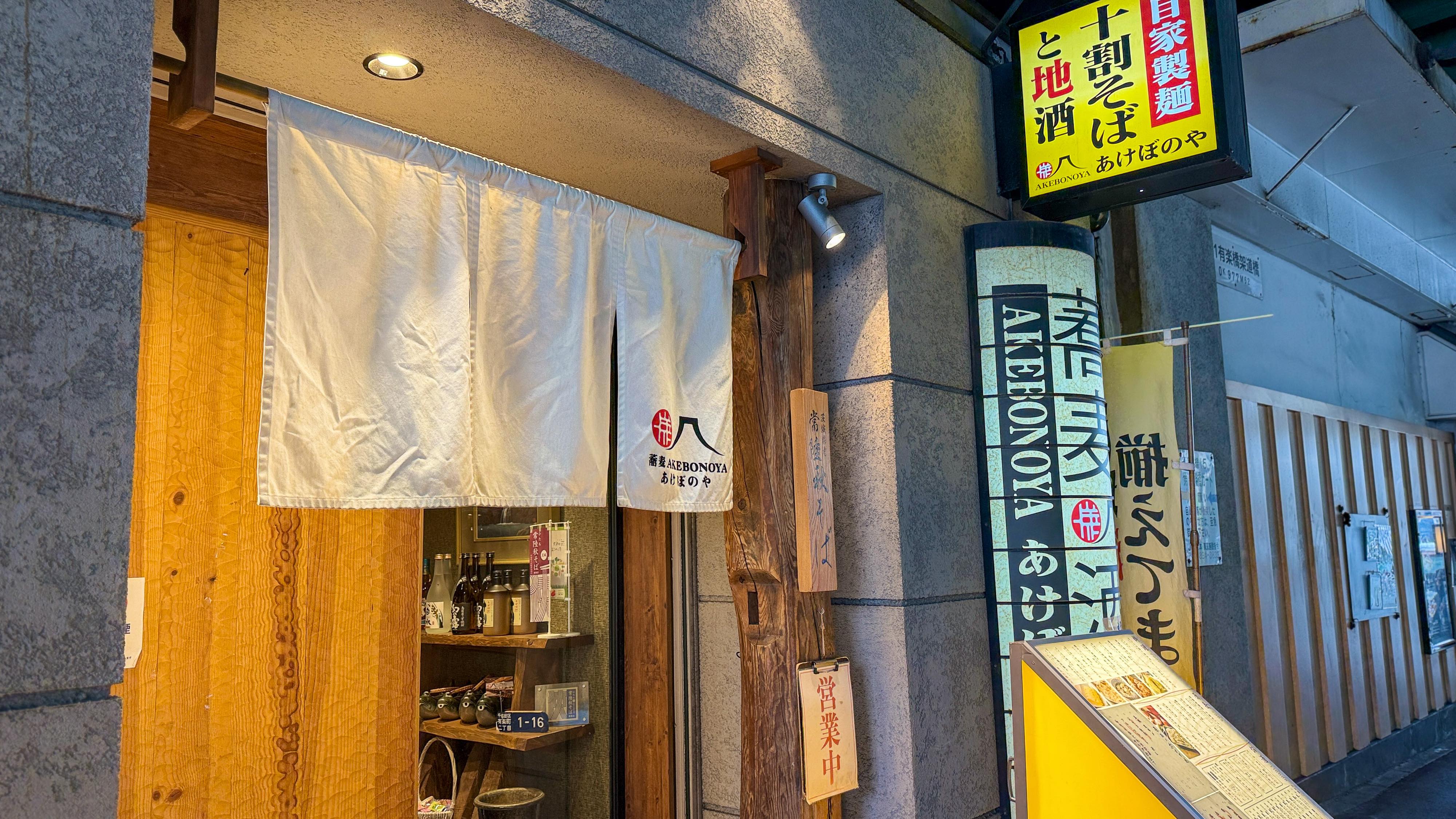
You would think a black-on-yellow, Jiro-style sign like this would be hard to miss.
Well, soba is about right for a hangover anyway. So in I went.
Tanuki soba 1,280 yen
Chilled tanuki soba 1,280 yen
Kamo-nanban soba 1,480 yen
There was all sorts on offer, and the izakaya dishes all looked good!
If I had not been hungover I might well have ordered a drink and settled in. But I was hungover, so let us set the drinking aside — what I chose this time was the chilled tanuki soba. Or rather, lately I feel like chilled tanuki soba is what I always order at a soba shop.
After a short wait, the soba appeared.
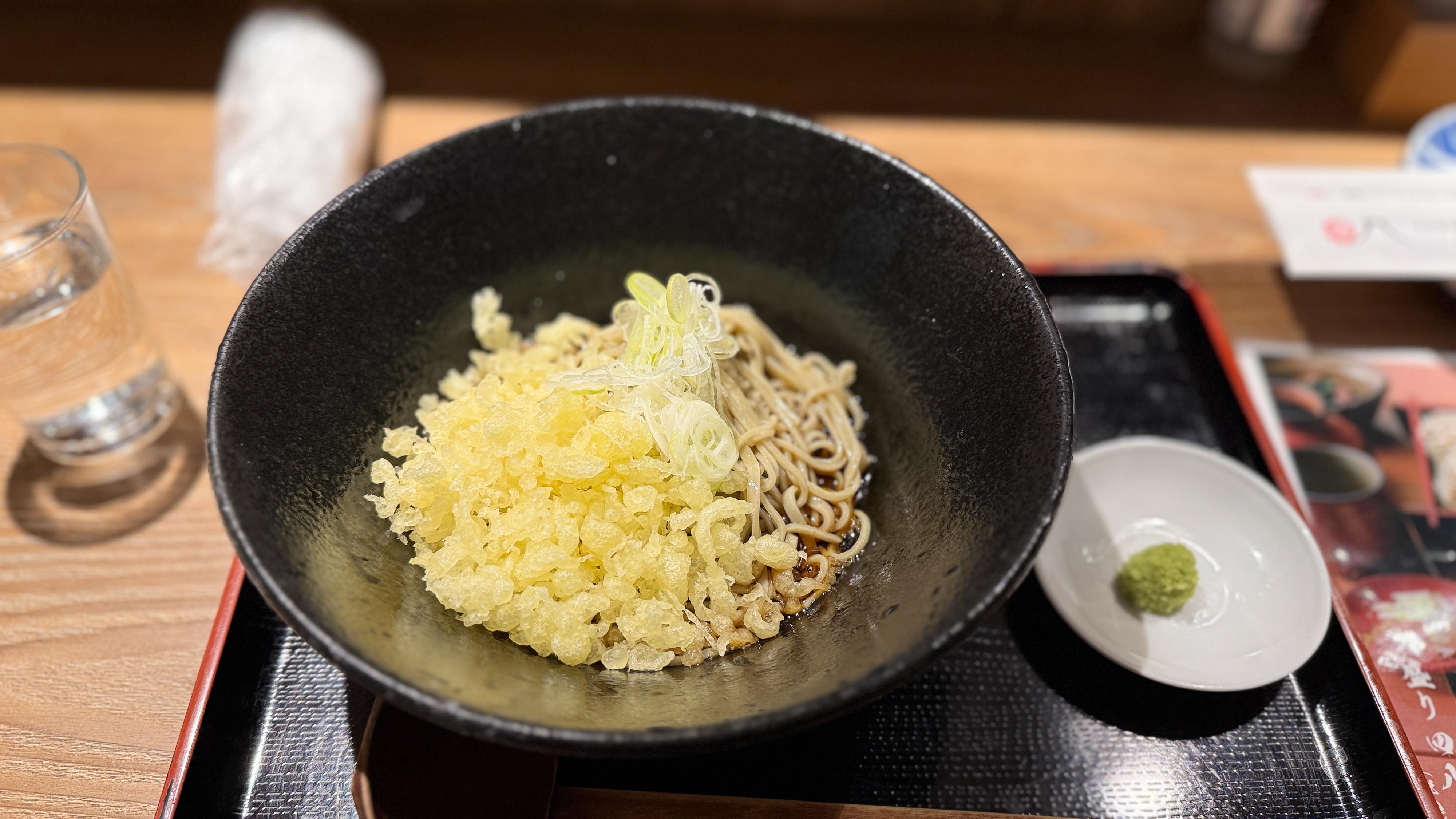
Very simple, is it not. Soba, agedama, negi.
But this chilled tanuki soba is the good stuff. Cold-tightened soba, with the aroma of the tsuyu.
Just where it might feel a touch thin, the fat from the agedama fills it in, and although it is plain soba, somehow it satisfies. The soba is said to be house-made juwari soba, but for juwari it had a notably smooth, slippery texture, which struck me as a little unusual. So you can get this texture out of pure buckwheat.

Later on, I had some sobayu too.
As you would expect from juwari soba, the sobayu is thick and looks like it is full of mucin — lovely. And sobayu for a hungover stomach, well, is that not just the thing. You can feel yourself recovering. Satisfied!
The price, well, I do think it is a bit high. For just eating soba, that is. You can get soba for about 600 yen readily enough. But taking into account that it is juwari soba, and that they have sake and things to nibble on too, I came to think this is about right. The location is excellent, so it might be a good spot to drop into for a second round — a few nibbles and a drink, then soba to close.
Akebonoya, House-Made Juwari Soba and Local Sake (Izakaya / Hibiya Station, Yurakucho Station, Ginza Station)
Tabelog lunch rating ★★★☆☆ 3.3
I ate here and paid for it myself. Nothing on this site is a comped meal.
One more for the road?


